Category: Mobile Marketing

Maybe Apple should find a way to be the best thing in your bathroom

It’s hard when you imagine yourself as the hottest thing on the block, when in reality you’re viewed rather low-down in the pecking order. For many this probably isn’t a concern, after all, it takes a special type of company to have delusions of grandeur. But, if there was going to be a company to fill that post, it’d be Apple.

The Californian tech-giant that produces brushed-steel desirables has found itself below the likes of British Airways, BBC, Microsoft, Google and Andrex in a recent consumer poll of brand popularity.

It’s certainly a telling sign when it’s positioned below it’s competitors, but even more damning when businesses that have seen a lot of negative attention recently rise above Apple’s shiny exterior. But, this is a consumer survey on brand loyalty, and it looks that most would happily defect from Apple to Microsoft. However, Samsung – Apple’s biggest competitor in the smartphone market – comes in even lower, not making the top 20.

The survey, carried out across a selection of 3,000 adults, placed British Airways as their number one, with Rolex appearing at the second place position. Personally I’m a little confused as to who they decided to survey, as Rolex may be a prevalent brand, but how many people are actually loyal enough to them, let alone own one?

“Apple and the other tech giants have suffered, with Apple particularly struggling to meet arguably unrealistic high expectations,” said Superbrands council chairman Stephen Cheliotis. “It is increasingly clear that in the short-term at least, Apple is struggling to maintain its enviable innovation record in the eyes of consumers while failing to inspire individuals without its hugely influential leader, the late Steve Jobs.”

And that’s quite true, since Job’s has left the business many have flocked to other brands that seem to be innovating and taking risks far more than Apple are. But with the likes of the recent scandals around the BBC, Coca-Cola’s lack of response to Winter Olympic host Russia’s homophobic attitude, and various issues with Microsoft’s Windows 8.1, consumers still rank those higher than Apple.

Here’s the list of the top 20 brands:

  1. British Airways
  2. Rolex
  3. Coca-Cola
  4. BBC
  5. Heinz
  6. Microsoft
  7. Google
  8. Gillette
  9. Kellogg’s
  10. BMW
  11. Cadbury
  12. Andrex
  13. Amazon.co.uk
  14. Apple
  15. Boots
  16. Nike
  17. Sony
  18. Marks & Spencer
  19. Shell
  20. Mercedes-Benz

Source: Vaughn Highfield – Total Customer.org


How Burger King throws away money with mass-market SMS approach

Burger King gets points for leveraging SMS to raise awareness of new products with a wide audience, but the brand is missing a key opportunity to drive sales by not customizing messages to activate recipients.

Burger King continuously uses MMS to push out promotions to its SMS database that tie into bigger marketing campaigns but lack a call-to-action to actually get a consumer into a restaurant. Quick service restaurants have been particularly active in SMS over the years in pushing out aggressive, time-sensitive offers, but Burger King’s initiatives highlight the importance in getting mobile right at the local level.

“Franchised QSRs operate within a web of corporate regulations, local market needs and limited marketing budgets,” said Zach Zimmerman, marketing manager at HelloWorld, Pleasant Ridge, MI.


“This fragmentation can make it tricky to execute localized and targeted mobile marketing campaigns,” he said. “Burger King appears to be using MMS at the corporate level to advertise national promotions, raising brand awareness of existing offers rather than delivering localized or mobile-exclusive discounts and promotions.”

Mr. Zimmerman is not affiliated with Burger King. He spoke based on his expertise on the subject.

Burger King did not respond to press inquiries.

Missed opportunity
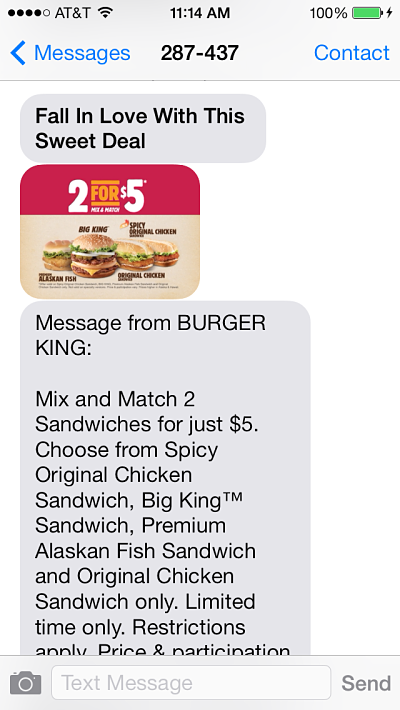
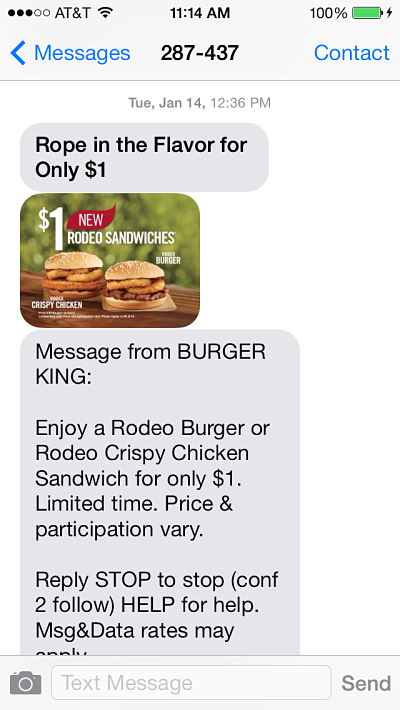
Burger King’s messages always include a picture of a product above a piece of copy that encourages consumers to try it out at a nearby location.

For example, a message sent last week from Burger King promoted a new offer for a $2.99 small hot coffee and muffin sandwich.

Underneath, copy read “Offer ends 2/28/14. Participating restaurants during breakfast hours. Restrictions apply.”

However, there is not any information on which stores the offer applies to or an incentive to encourage consumers to go into a store.

Burger King could have used a variety of different tactics to make the message more effective – including a video or a link to a store locator or coupon.

Additionally, the SMS messages could be segmented towards specific markets.

Alternatively, the images that are already included in messages could be turned into incentives to get consumers into stores. For example, a piece of copy could encourage consumers to show the picture to a store employee to receive a coupon or offer.

Other recent similar messages have included a Valentine’s Day promotion for a deal on sandwiches, $1 burgers and a holiday promotion for gift cards.


BurgerKing_02BurgerKing_01


Stacking up to the competition
Compared to Burger King, competitors Jack in the Box, White Castle and Carl’s Jr. seem to be getting SMS and MMS right at the local level with campaigns that activate in-store traffic.

During the recent Super Bowl, Jack in the Box stirred up some hype leading up to its TV spot that debuted a new cheeseburger with an MMS blast. The message gave consumers a sneak peek at the upcoming ad and an image of the product that could be redeemed as a coupon in-store.

Additionally, 40 Carl’s Jr. locations in Texas and Oklahoma reported a 17 percent mobile coupon redemption rate as a result of sending out local offers. The coupons are redeemed by typing in a code at the point-of-sale.

White Castle also tapped mobile last year to set up customised location-based SMS alerts.

Focusing on local markets like these brands are doing can pay off for QSRs with coupon redemptions and in-store traffic, according to Jeff Hasen, Seattle-based chief marketing officer of Mobivity.

“We’ve seen terrific recent success with QSR clients driving people into the store during the Polar Vortex and for product introductions that actually yielded higher sales despite giveaways of product or reduction in price,” he said.

Additionally, both Carl’s Jr. and White Castle’s campaigns are part of more integrated campaigns that the chains are using to build up loyalty and drive repeat traffic.

“QSRs should use mobile as a part of their loyalty programs,” said Aaron Clark, vice president of mobile sales and operations at HelloWorld.

“Rewarding customers for repeat orders or visits ensures they will return and creates a rich engagement between consumer and brand,” he said. “For example, if you’re only a few points from getting a complimentary meal somewhere, you’re more likely to go there to eat and get those extra points over choosing a different restaurant.”


Losing relevance?
Although marketers do not appear to be slimming down their mobile messaging initiatives, consumers are increasingly becoming less responsive to messages that bombard their mobile devices.

Take Facebook’s $19 billion acquisition of Whatsapp, for example.

With consumers using their mobile devices in new ways to connect with their friends and family members, there is a possibility that SMS-based campaigns could dwindle in relevance for marketers eyeing social media and other tactics to connect with consumers.

Therefore, it is critical that marketers do not invade consumers with un-relevant or too many messages.

“As marketers, we need to reach people where they are most, which is their mobile phones,” HelloWorld’s Mr. Clark said.

“If a customer is opting in to receive mobile messages from a brand, app, etc., it’s because they want to receive that information to their phones, so it’s imperative to make sure you’re leveraging that request for frequent engagement in an effective manner,” he said.


Source: Mobile Marketer

Impact on marketing of Facebook’s $19B acquisition of WhatsApp: Big zero

Facebook’s plan to acquire mobile messaging service WhatsApp for $19 billion has earned the ire of frustrated media, competitors and industry pundits, and the envy of those VC-backed, revenue-less digital wonders waiting in the wings to be swooped into Google’s or another Silicon Valley giant’s arms.

Before discussing what this means for marketing, here is what this acquisition may really be about: an effort to dazzle and arrest decline by an over-valued social media company that is recognizing how fleeting user loyalty and advertiser revenue can be. In other words, Facebook – with its 1.2 billion accounts – has tied India to become the world’s second-most populous entity after China, but quantity has not translated to sales – as many marketers eyeing the two Asian countries have discovered.

What’s up …
If media accounts are any indication, Facebook is shedding young consumers at an alarming rate, something that is not attractive to advertising agencies making media-buying decisions or advertisers paying the bills.

Another strike against Facebook is the lack of a sustainable revenue stream. Even as it boldly pivots to becoming a mobile company – and who has not heard that shout across rooftops – Facebook will soon discover that advertiser money flees with the audience, especially if impressions and click-throughs do not lead to brand lift or sales.

Now would be the time to trot out a big case study on how Facebook helped a brand achieve its goal with measurable results in terms of higher consumer engagement or more sales. Now would be the time to showcase how mobile buying on Facebook across mobile and online channels convinced advertisers that ad interruptions in a social context – or confusing readers to distinguish ads from user content – is the right environment to generate positive feelings for the advertised brands. Do not hold your breath, for it is not in the nature of the uncurated social media crowd to be judged by the same metrics that other media are.

What has happened is clear: Facebook is buying relevance, even if that lead will evaporate in a couple of years when a new application or service will supplant WhatsApp. Wall Street, in its usual blurred understanding of Silicon Valley’s shenanigans, will salute this deal through with a slap on the wrist of a few percentage points shaved off Facebook’s share price in the short term. And then it will be business as usual for the very investment bankers, banks and venture capitalists who shuffle the money chairs on the decks of yet another Titanic bubble about to burst in a year or two when the market will suddenly discover the iceberg in its path: social media revenue growth is not sustainable simply because audience interest in evolving platforms is not.

Any social content and communications model that requires the customer to do the heavy lifting on a consistent basis will not thrive – Facebook is not IKEA. The audience will tire and will move on to a new platform. It simply is the nature of the beast. At one point, it was Facebook that was the cat’s whiskers. Then it was Twitter. Then SnapChat, and now WhatsApp. Bet on something else in a year. In the meanwhile, 55 employees of WhatsApp, including the two founders, and partners at Sequoia Capital – which poured in $60 million to fund the messaging app and will receive a $3 billion payoff – will soon be shopping for a grander lifestyle.

… comes down
Funnily enough, if Facebook was really interested in controlling the messaging environment, it should have made a pitch for T-Mobile, the nation’s fourth-largest wireless carrier that is in play. Carriers are the new mobile gatekeepers. Or it should have bid for Time Warner Cable, one of the top five cable companies that controls Internet, wireless and television access to tens of millions of U.S. households.

FacebookMobile advertising on Facebook is growing quickly

So will this deal have any trickle-down effect to brands and retailers? Highly doubtful. WhatsApp built its credibility by eschewing ads. It charges only 99 cents a year after the initial year of free usage by a subscriber. So the grand total of revenue from that stream is $450 million, if all 450 million users continue to use the service year after year, even factoring in churn. Facebook has not announced its intentions on integrating ads into the service, so brands cannot be part of the fleeting WhatsApp message exchanges. Facebook CEO Mark Zuckerberg went on record Feb. 19 to say that ads are not the right way to monetize messaging systems – and he is right on that count.

Which means that the ad agencies are left high and dry and without the ability to play middleman in the creative and media planning and buying processes of the world’s largest mobile acquisition so far.

And publishers? They are keeping fingers crossed that overwhelmed advertisers really do not squander their budgets on the latest shiny object from that new weaver of American dreams: Silicon Valley, or Sollywood.

Read the entire article

Author: Mickey Alam Khan (Editor MMD)

Marketers still overlook in-app ads, despite consumer behavior

As consumers spend more time within mobile applications, marketers are beginning to understand the opportunity of in-app advertising and throwing more money behind the channel, but experts believe marketers are still behind in the game.

According to a report from Maz, consumers spend 40 percent more time reading content in apps than on Web sites, but marketers are still hesitant to ramp up in-app ad spend. At the same time, Juniper Research just put out a report that predicts that in-app advertising spend will grow to almost $17 billion by 2018, so that reality may be changing in the near future.

“The mobile app market is a huge, fast-growing market with over 1 million apps, $26 billion in revenue and 102 billion downloads in an industry that didn’t even exist five years ago,” said Marc Parrish, an advisor at Appboy, New York. “Any marketer who is not looking to increase spend in reaching this channel has his head in the sand.

“Most marketers don’t even know that in-app ads exist as a format,” he said. “Facebook is the forcing function, educating the marketing that there is money to be made in mobile ads.

“Facebook’s mobile monthly average users increased 45 percent in just a year, from 604 million monthly average users in the second quarter of 2012 to 874 million monthly average users in the third quarter of 2013. That’s serious growth.”

Consumer behavior
When it comes to advertising, marketers should always respond to consumer behavior in order to reach consumers where they are.

In this case, consumers are clearly spending more time within apps.

According to Maz, a company that powers more than 600 apps in Apple’s App Store, Google Play and Amazon Appstore, consumers spend 40 percent more time reading content in apps than on Web sites. Consumers spend the most time with entertainment publications, at an average of 38 minutes per issue, with sports coming in next at 23 minutes per issue.

Apps such as American Media-owned Star Magazine, Country Weekly and Soap Opera Digest are seeing consumers return to an app for up to 12 sessions per weekly issue. The entertainment app average is seven sessions per issue.

“In general I think people are spending more time on mobile devices, and most of the time is spent within apps,” said Shouvik Paul, vice president of business development at Maz, New York. “It’s not very often that you open up your browser on your phone and type in facebook.com, you just go to the Facebook app or Twitter app.

“Another big feature of apps in general are push notifications, specifically on a lot of the Apple devices,” he said. “If I have the app, it notifies me when there’s breaking news, so I don’t have to remember to go to it.”


An infographic from MAZ

Ad spend
If consumers are spending more time reading in apps than Web sites, it makes more sense for brands to be investing on a higher level on apps to get in front of those consumers.

According to Juniper, marketers will begin to understand this opportunity in the next few years.

A new report from the research firm predicts that in-app mobile ad spend will reach $16.9 billion by 2018, up from $3.5 billion last year. The report expects that in-app ad spend will grow at a higher rate than mobile Internet, messaging and ringback tone ad spend.


Mobile ad spend in 2018

A number of brands have already begun tapping into this opportunity. For instance, Starbucks recently launched a new campaign that mixes sponsored content and full-page ads into the Flipboard mobile application.

Dating site AYI has also seen success with in-app ads. The company saw more than a 200 percent increase in application downloads since leveraging mobile app install ads on Facebook.

However, Mr. Paul thinks that marketers are not yet doing enough when it comes to in-app advertising.

“There’s huge room for improvement in apps,” Mr. Paul said. “The app world in general is still in its infancy. If you think about the early days of the Web, advertising then was pretty terrible. Nobody really knew what they were doing. And that’s what we’re seeing now in the app world.

“We work with a lot of magazines like Forbes or Us Weekly, all these magazines have a lot of ads,” he said. “They expect users to see that Gucci ad in a magazine and tap on it. If you tap on it, it can play a video or open the advertiser’s Web site in the app. The problem is there’s no real call-to-action.

“The technology exists where you can have someone transact right within the app, yet marketers are using it much like they do with standard print magazines where it’s just about the branding. There’s a lot more they can do in terms of tap here to go purchase this pair of boots you’re seeing on this model.”

Source: Mobile Marketer Daily

Author: Rebecca Borison

Home Computer Of The ’80s To Be Reborn As Retro Gaming Keyboard For iOS

In the U.K., the iconic 8-bit home computer of the 1980s was the Sinclair ZX Spectrum. Few keyboards have surely been pounded as hard as the Spectrum’s rubberised compliment of grey rectangles.

spectrum image

Released in 1982, the 48K computer-in-a-keyboard was last produced in 1990. But if this Kickstarter campaign (from veteran Spectrum games dev Elite) hits its funding target then the ZX Spectrum will be reborn as a Bluetooth keyboard for iOS, initially, with plans to add support for Android, Windows Phone, PCs and Macs down the line.

Elite is seeking £60,000 (~$99,000) in crowdfunding to fund production of the first 1,000 units and bring the Spectrum back to life. The Bluetooth ZX Spectrum will be able to be used, not so much as a tough-to-type-on Bluetooth keyboard, but to recreate that authentic rubbery Spectrum gaming experience in conjunction with future app releases from Elite that will be available to buy from the iTunes App Store (and later from Google Play, Amazon’s App Store and Microsoft’s Windows Store).

The Bluetooth ZX Spectrum keyboard will also be backwards compatible with Elite’s existing ZX Spectrum: Elite Collection apps — which feature Spectrum gaming classics such as Jet Set Willy, Manic Miner, Cybernoid, Monty on The Run and Skool Daze (to name a few). The apps will be sold separately to the keyboard — which is being priced at £50 to early Kickstarter backers (which includes Elite app credit and delivery in the U.K.).

The Bluetooth ZX Spectrum keyboard may also work with some third party apps — so you could use it for other keyboardy functions, albeit the form factor was never designed for speedy touch-typing — but Elite notes that compatibility cannot be guaranteed.

Elite is licensing the ZX Spectrum trademark and has been granted the right to replicate the Spectrum’s form factor — and says it’s the only company that has been granted that right from the IP holder.

Nostalgia fans should direct their clicks to Elite’s Kickstarter page. The company has raised £17,000 of its £60k target so far — from more than 280 backers, and with 28 days left to run on the campaign. If successful they are aiming to ship the Bluetooth ZX Spectrum keyboard to backers next September.

Source: Tech Crunch

Author: Natasha Lomas

Buying Local will beat Online shopping in 5 years says IBM…

IBM, known for its pioneering research in almost all things technical, has predicted that eCommerce may well lose out to physical retail in the next five years.

In a recent series of predictions from IBM, known as the ’5 in 5′ – which takes an educated guess at the innovations that’ll change our lives in the next five years – IBM has cast it’s eye over to the retail sector. It hasn’t taken a conservative approach to the future either, making a prediction that would surprise many involved in the industry: online will eventually lose out to brick-and-mortar retail.

Obviously this isn’t what many would expect, after all, online stores have enjoyed success for a while now, and behemoths like Amazon dominate the space without the need for any physical stores. There are other companies, such as WalMart, BestBuy and Tesco who have a rather healthy grasp on both the online and offline world of retail. But for the most part, if you’re not doing well in the online relm, you’re probably beginning to flounder on the high-street too.

So, what’s led IBM to think that things will change so drastically in the next five years? Well, thanks to research its doing with various retailers around the use of ‘cognitive computing’, it believes that customers can finally have the immediacy of physical shopping, with the “intelligence” of online.

This means that your customers will be able to walk into your stores and instantly be recognisable to staff. These staff members will know past shopping habits and anything a customer could well be interested in buying, meaning that when they decide to look for some help, they’ll instantly be given the help they want most. Of course, customers don’t have to go looking for help as mobile apps and augmented reality apps will help make their browsing experience in your stores far more seamless.

It’s a little sketchy on how it plans to deal with fulfilling customer’s desires to take an item home that day, after all a local store may not have that item in stock – or may not stock it – meaning that online could well win out in the delivery stage of purchases.

Speaking to Venture Beat, Vice President of Innovation at IBM, Bernie Meyerson, elaborated on why IBM believes the future of retail is in physical stores.

It’s not just about customer fulfilment, it’s also about creating an infrastructure that allows customers to gain insight and experience products hands-on. It also helps reduce the issues that surround online delivery, such as the vast amount of transport needed to shift items across the country. He believes it’s a way to help reduce pollution.

Meyerson also believes that this future of retail would be far more secure and private than shopping online where data is stored for humans to look at alongside your personal information. Here, in IBM’s stores of the future, you could come in, be offered the right products for you by a computer, and leave with nobody the wiser as to what you’ve bought.

The most interesting thing of all is that this vision of the future isn’t the ‘Us Vs. Them’ of physical against online, both competing for sales. Instead, this is a totally omnichannel approach, one that combines it all into one experience in a store. As Meyerson says “you’re combining the best of both worlds.

“On one hand you have a very personal relationship, which some people do prefer. At the same time, the technology they have available to serve you is as good as anything that’s been available in online shops. It’s an interesting evolution, and it is coming.”

Meyerson concluded by saying, “As you probably may have heard, there are a number of online shops that have talked about setting up brick-and-mortar showrooms, for this precise reason.”

Author: Vaughn Highfield

Source: Total Customer

Take your Mobile Marketing to the next level in 2014!

If your using text messaging as part of your marketing strategy, you will no doubt understand the types of text messages you can send, but you may not have an SMS system that can perform to the highest standards and give you visibility of your channel spend.

Or you may find yourself due to renew and existing SMS platform contract and want to know what else is out there… either way, you need to know all about the latest and best Mobile Marketing techniques in order to stay ahead of your competitors.

If your serious about Mobile Marketing and you want to generate more revenue / customer interaction through it this year, then read on…..

Lets review everything we told you during 2013 across your mobile channels;

Choosing your Mobile Partner

Choose a Mobile Partner who can grow your ability to target customers in real time….

Standard SMS Messaging

How to get started with Mobile Marketing – best practice introduction….

MMS Messaging

Pictures speak a thousand words….

Premium Rate Messaging

Content driven messaging used in conjunction with a loyal customer base can provide a steady income…..

Advanced SMS Messaging

Why not trigger the correct response message from hundreds of possible responses on an individual basis…..

And it doesnt stop there… Mobile Marketing can offer you a plethora of other services such as…..

Mobile Site Poll / Survey Data Capture Campaigns

And you can utilise the mobile channel in conjuction with any other channel that forms part of your convergent marketing strategy. Use Email, Voice Services or Online marketing channels in conjunction with mobile and get instant communication and responses from your customers.

So whatever you plan on doing marketing wise in 2014, make sure mobile forms part of your strategy and give us a call on 0161 874 4222 or find us online at http://www.so-mo-lo.co.uk

Happy New Year from all at So-Mo-Lo and Good Luck with your comms in 2014!!!

themobileexpert…

SoMoLo_Signature_Xmas_01

Top 10 location-based mobile advertising campaigns of 2013

Location-based ads gain steam

The rise of geo-conquesting, navigational applications and an increase in sophisticated data made campaigns from Toys “R” Us, adidas and Jack in the Box stand out in the mobile space this year.

Marketers significantly beefed up their mobile advertising this year with tactics that go beyond driving in-store traffic and instead use branded apps, search and integrations into third-party navigational apps such as Waze to lure in interested consumers. This will continue into 2014 as marketers tie in additional pieces of data indicating intent to make mobile campaigns more contextually-relevant.

Here are the top ten location-based advertising campaigns this year, in alphabetical order.

20pc of adidas mobile store locator visits result in in-store traffic
Adidas, iProspect and Google worked together earlier this year to measure the impact that mobile search has on in-store traffic.

First, adidas linked mobile search campaigns with location extensions to drive consumers who were searching for a store straight to the store locator page on the brand’s mobile site.


Adidas’ mobile site

IPropsect then used adidas’ internal data to estimate that one in every five clicks on the store locator page led to an in-store visit.

The companies then theorized that 20 percent of in-store visits result in a purchase with an average order value of $80, making each store locator click worth $3.20 and resulting in a 680 percent incremental lift in ROI.

Adidas’ campaign underscores the importance that linking up mobile and in-store traffic is playing for marketers. As marketers look to better understand mobile’s value, similar tests will likely be done in 2014.

Best Western mobile ad generates 0.95pc CTR
Best Western ran a location-specific campaign in the state of Washington around airports and competitors to encourage consumers to book a hotel.

Best Western worked with PayPal Media Network on the campaign that let consumers either book a hotel instantly or view a map.


Best Western’s mobile ad

The combination of geo-conquesting — or targeting consumers nearby to competitors’ locations — and geo-fenced ads around airports in Best Western’s campaign shows how marketers are making location the focal point of their mobile advertising efforts.

The campaign also shows the potential for mobile advertising to sway last-minute sales as consumers rely more on their mobile devices to make travel decisions on the spot.

Coors Light propels foot traffic via location-based mobile ads
MillerCoors’ Coors Light took a unique twist to drive traffic into bars and restaurants.

The beer brand ran mobile ads inside sites and apps such as The New York Post and CBS News during the football playoff games.


Coors Light makes mobile advertising local

When consumers clicked on the ads, a branded landing page with a map is brought up that shows nearby restaurants that serve Coors Light products.

Since Coors Light likely will not be selling a beer directly through mobile any time soon, a location-based ad is a smart way for the brand to drive consumers into locations to try one out.

Dairy Queen tries location-based advertising to increase summer foot traffic
Dairy Queen bet on mobile advertising this year with a campaign to show consumers where they can find Orange Julius locations inside the ice cream shops.

Banner ads within Fandango’s mobile site expanded when clicked on to pull in a map of nearby locations. The map could be zoomed in and out of to view directions and contact information.


Orange Julius locations plotted on a map

In 2013, mapping data and location has increasingly become more sophisticated, and Dairy Queen’s ad shows the gains that marketers have made in terms of driving foot traffic through mapping.

Fiat helps Waze users find nearby relaxation spots to avoid traffic
Automaker Fiat was one of several brands to leverage the mobile application Waze this year to serve up location-based ads to consumers.

Fiat ran the campaign in Brazil and targeted drivers that were near rest stops. When consumers click on a branded icon, copy encouraged drivers to pull over and take a break from the traffic.


Fiat tries Waze in Brazil

Waze was acquired by Google in June for $1.03 billion to help the company strengthen its location-based offerings, and other brands including Universal Pictures and Interscope Records have also leveraged Waze with local, relevant offers.

What is interesting about Waze as a marketing platform is that the app has its roots as a utility service that uses live maps to offer consumers turn-by-turn directions, making ads less of a distraction since they are surrounded by relevant information.

Jack in the Box delivers on mobile’s promise of location-based relevancy
In October, Jack in the Box ran a mobile advertising campaign that put location at the forefront. 

The campaign ran within the Pandora iPhone application and pulled in several pieces of information to eliminate the need for a landing page. Instead, consumers could type in their ZIP code to find a store location straight from the ad unit itself.


Jack in the Box’s location-based ads

QSRs lead the pack of industries leveraging mobile advertising to drive in-store traffic, and Jack in the Box’s ad shows the gains that marketers are making in perfecting the location-based ad.

Outback Steakhouse leverages mobile location to target competitors’ customers
Outback Steakhouse was one of many brands to take standard geo-fencing up a notch with geo-conquesting.

The steakhouse chain ran a campaign that generated a 78 percent lift in click-throughs for ads that were served within five miles of a competitor’s location.


The Outback Steakhouse mobile ads

Additionally, post-click activity was highest on the portion of the campaign that was targeted towards competitors. The campaign generated an 11 percent lift in conversion actions such as finding a nearby store than standard geo-fenced campaigns.

Outback’s campaign highlights the growing role of location for marketers this year in driving in-store traffic. As geo-fencing has become more mainstream in the past few years, geo-conquesting is a way for marketers to differentiate their campaigns and win over consumers with aggressive offers.

Peter Piper tries location-based advertising to build SMS database
Pizza chain Peter Piper rolled out a pilot program to several of its Texas locations this year that targeted in-app ads to consumers who were nearby stores.

The ads were day-parted to either serve lunch or dinner offers to consumers and included a call-to-action that prompts consumers to type in their mobile phone number to join Peter Piper’s SMS program.


The Peter Piper ads

To build an ongoing relationship with consumers after they clicked on the mobile ad, Peter Piper chose to start building up an SMS database, pointing to the need from marketers to load mobile ads with calls-to-action that drive long term engagement.

Piaggio Group Americas sees 4.69x increase in CTR for retargeted ads
Piaggio Group America ran a mobile advertising campaign this year that leveraged location data to serve up retargeted ads that drove a 0.75 percent click-through rate, more than four times what untargeted ads generate.

The brand used location data to identify consumers who had previously visited Vespa and Moto Guzzi dealers and then retargeted them with location-specific ads.


The location-based mobile ads

According to PGA, the average consumer buying a Vespa spends two to three months researching before they buy. Therefore, utilizing location data keeps the brand top of mind for consumers, and PGA was able to target only the consumers who are interested in its products.

Will brands latch on to post check-in foursquare ads?
Toys “R” Us and Diageo were two of the first brands out of the gate to test a new type of foursquare ad this year.

The post check-in ads aim to serve up relevant offers and content based on the location of a check-in. The ads can either be used on the spot or saved to the app to be redeemed later.


A post check-in ad from Toys “R” Us

Foursquare has been actively pushing itself away from solely a check-in app in the past couple of years since consumers are not as interested in check-ins if there is not a distinct value.

With a growing number of advertising opportunities, foursquare is hoping to lure in some marketing spend from big brands that want to target specific consumers by location and could be a big area of focus for marketers in 2014 if behavioral or social data is layered into ads.

Author: Lauren Johnson

Lauren Johnson is associate reporter on Mobile Marketer, New York

Tesco installs window QR codes for interactive shopping

UK grocer Tesco has set up QR and augmented reality codes in the windows of 11 of its Metro stores across the country, giving passers-by the chance to order and pay for goods on their mobile devices without entering the physical shop.

In what is turning out to be a month of technological experimentation at the UK’s largest retailer, it was announced today that the supermarket group is using new technologies to allow customers to find out more information about the products displayed in the virtual shop window.

Products featured will include Christmas gift ideas such as children’s bikes, best-selling toys and Tesco’s new homeware range. Once the code is scanned, the product comes to life using augmented reality on the customer’s smartphone, and then they can arrange to click & collect from the same store within 24 hours.  

Already this month Tesco has introduced electronic shelf labels in one of its stores and a mobile app specifically for its employees, which can be used on the company’s own hudl tablet and other smartphones and mobile devices. Last week Tesco opened a tech-focused distribution centre in Erith, which will support the business’s growing online operations.

All of this innovation comes at a time when the company is looking to establish itself as a multichannel leader, while it struggles for like-for-like sales growth in all of its global markets. In a third-quarter results announcement last Wednesday, comparable sales in the UK were down 1.5% on the same period one year before.

Introducing new ideas and innovations is viewed as an essential part of the retailer’s strategy as it looks to attract customers in a hugely competitive UK grocery market, and another example of this arrived on Saturday 7 December with the unveiling of a new high street Christmas window at its Regent Street Metro store.

A 6-foot biscuit house has taken centre stage at the Regent Street store, framed in a distinctive Christmassy Scandi style snow setting. Tesco’s finest food range is displayed, along with gifts and decorations. All product and decorations on show are available at Tesco.com, but the Regent Street store is not using QR code technology.

Robert Folly, store manager at Tesco Metro Regent Street, commented: “The team and I were so excited to be chosen for the first Tesco Christmas window display.

“We hope that our customers enjoy it, the biscuit house looks good enough to eat so we may have to keep an eye on keeping the windows and doors intact until the big day.”

The stores where Tesco is trialling the use of QR codes on windows are, as follows:

  • Newcastle Eldon Square
  • Bristol Broadmead
  • Canterbury
  • Gravesend
  • Harlow
  • Peterborough

Augmented reality will be in the following locations:

  • Kensington High Street, London
  • Birmingham Caxton
  • Manchester
  • Cardiff
  • Liverpool

Source: Essential Retail    Author: Ben Sillitoe

The Open Secret Of iBeacon…

..Apple Could Have 250M Potential Units In The Wild By 2014

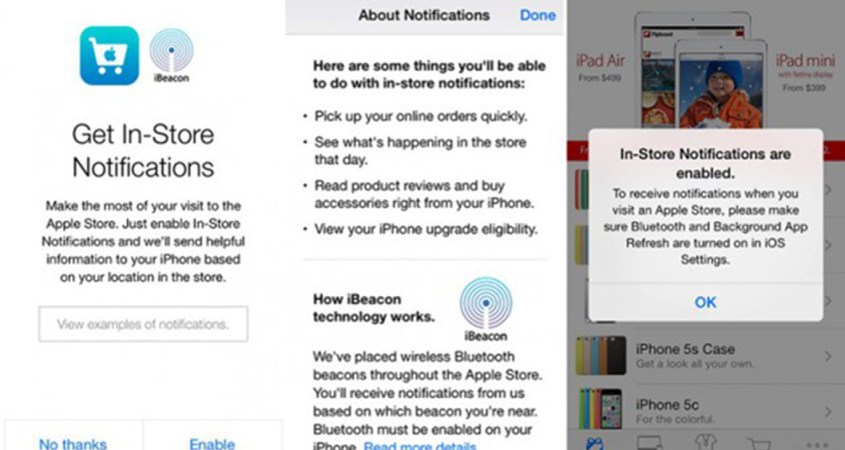
Yesterday, Apple began a small press push on its new iBeacon technology, pushed an Apple Store app update to support them and turned the feature on in 254 U.S. based stores in an initial rollout. According to the details we know so far, some Apple stores may have as many as 20 iBeacons deployed, depending on the size.
But the size of that rollout is deceptive for a couple of reasons — and the full implications of the impact on Apple’s iPad business, the internal mapping industry and the retail market are far bigger than anyone has really copped to.
Specifically, most of the coverage of iBeacons so far has failed to recognize a very important reality of this system: every iOS device since the iPhone 4S and iPad 3rd gen is already capable of being either an iBeacon receiver or transmitter, as long as it’s properly configured.
Yes, there are separate devices like Estimote’s beacons that can use Bluetooth LE protocols to act as a beacon, and Apple is using separate, specialized iBeacon devices that look like small silver rectangles tucked under shelves in some stores.
But some of the iBeacons deployed in Apple stores are not specialized hardware at all, they’re just regular iPads or iPhones that have been configured as iBeacons. And that capability extends to any Apple device with Bluetooth Low Energy and the latest major version of iOS. Let that sink in for a minute and you’ll start to realize the forward thinking strategy Apple has been implementing over the course of the last few years.
According to estimates by Creative Strategies Analyst and Techpinions columnist Ben Bajarin, an estimated 170-190 million iOS devices are currently capable of being iBeacons — that is they have the right hardware and are running iOS 7. That number could swell to 250M if holiday sales of iPhones and iPads are strong. Bajarin notes that Apple’s anticipated China Mobile deal could put them over 200M in iPhone sales in 2014 alone.
This means that every compatible iPad currently deployed in a retail store is already capable of being configured as an iBeacon transmitter — and every iOS device with Bluetooth LE can be a reciever. And the iPad is already enormously dominant in the retail space. We spoke to Scott Paul, CEO of ArmorActive — a tablet enclosure solutions company — about their deployments of iPads and other tablets as digital signage, kiosks, information panels and more.
Some 90% of ArmorActive’s sales involve iPads, 88% of its customers are using iOS, 10% use Android, and only 2% are on Windows devices. The company has been installing iPad solutions since late 2010, when the iPad was launched. They handled the installation of iPads in Kate Spade stores that made a splash earlier this year. To date, they’ve deployed nearly 50,000 tablet kiosks in hotels, restaurants, retail and other locations. Paul says that they have seen demand for Android tablets wax and wane as ‘hot’ models like the Nexus 7 have hit the market.
read more

Author: Mathew Panzarino (TechCrunch)